
So let me ask you something, and be honest with yourself here.
Have you ever told someone you’re a magician… and almost instantly they light up and say, “Oh amazing — do a trick”? And in that exact moment, something very strange happens.
Your mind, the same mind that has spent years learning sleights, studying theory, buying books, downloading lectures, practicing moves until your fingers ached… that mind just quietly steps out of the room.
It’s not that you forget one trick.
It’s not that you’re a little rusty.
It’s more like a total system shutdown.
You know you know magic.
You know you’ve practiced.
You know you own more material than any reasonable person should.
And yet, standing there, with people watching, you’ve got absolutely nothing.
If that’s ever happened to you, then genuinely — you’re exactly who this book is for.
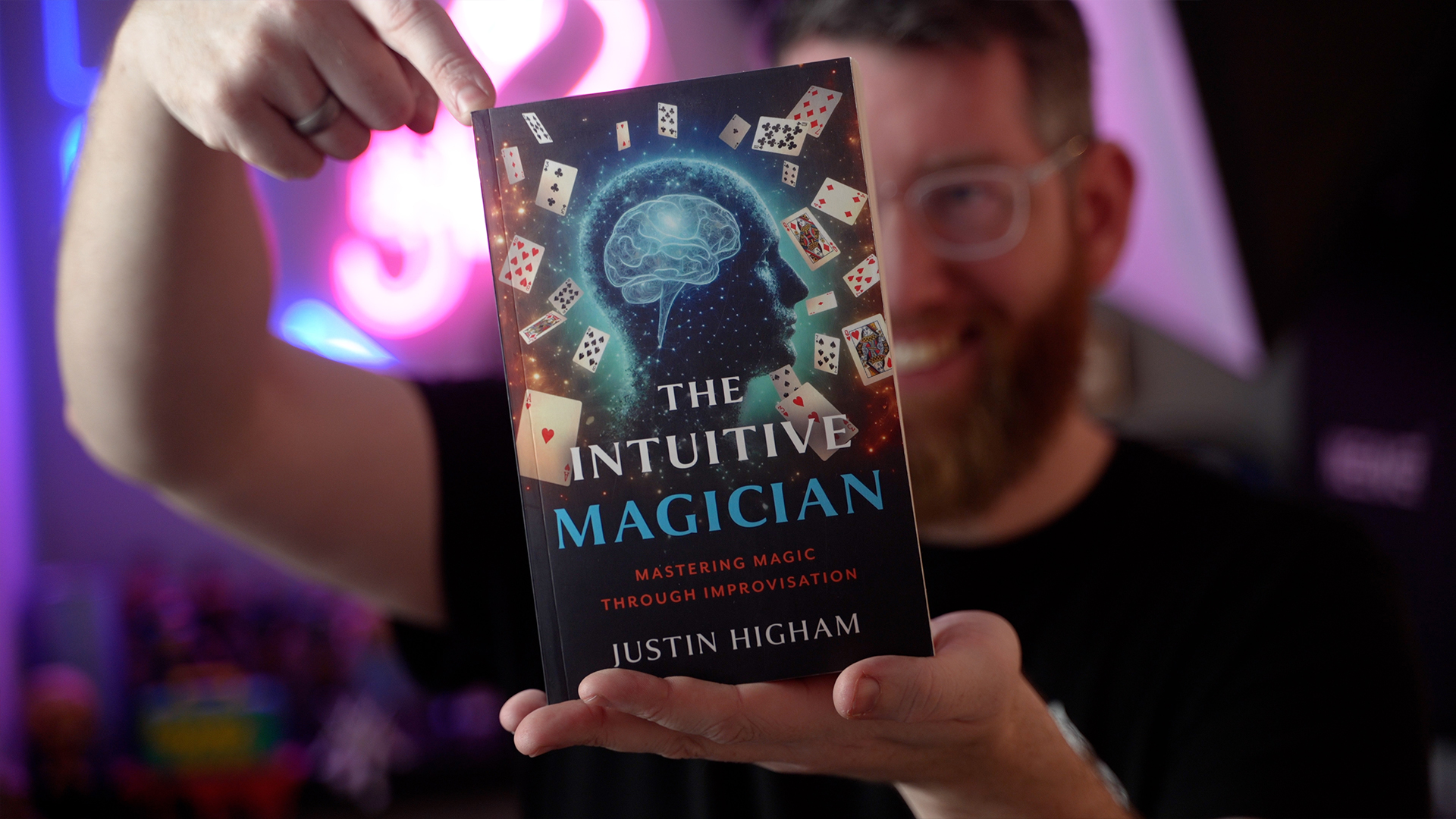
Today I want to talk about The Intuitive Magician by Justin Higham, which is one of those rare magic books that doesn’t teach you a single new trick… but instead calmly, and sometimes uncomfortably, explains why you keep falling apart when it actually matters.
And honestly, reading it feels equal parts comforting, confronting… and just a little bit insulting.
Because at a big-picture level, the book is asking a very uncomfortable question. Why is it that magicians who know loads of magic struggle so badly in impromptu situations?
Why can you rehearse for hours alone and feel completely fluent… but the second someone unexpectedly asks you to perform, everything disappears? Higham’s answer is simple — and slightly brutal. Most magicians are training the wrong part of their mind.
We’re very good at training the intellectual brain. We drill steps, sequences, routines, structure, theory. We analyse methods. We refine scripts. We categorise techniques.
But live performance doesn’t happen in that neat, intellectual space.
And when pressure hits, the intellectual brain is usually the first thing to shut down.
Which, when you hear it put like that, explains a lot.
Early in the book, he talks about something called performance paralysis — that horrible spotlight sensation where your hands suddenly feel unfamiliar, your breathing sounds too loud, time seems to stretch, and you become hyper-aware that everyone is looking at you.
You’re not even into the trick yet… and you already feel like you’re doing it wrong.
He compares it to athletes getting “the yips.” Your body knows what to do. Your hands absolutely know what to do. But your thinking brain barges in and starts interfering.
And the cruel twist is that the harder you try to think your way out of it, the worse it gets.
Which, of course, is exactly what most of us do.
That leads into one of the central themes of the book — intellect versus intuition.
Now, this isn’t an anti-intelligence rant. Higham is clearly analytical and extremely well read. But he makes a strong case that intellect is a terrible leader during live performance.
If you’ve ever tried to consciously think about how you walk, or how you type on a keyboard, you already know how quickly that kind of awareness makes things clumsy.
Magic works the same way.
The moment you start narrating your own actions in your head — “Okay, now double lift. Don’t flash. Relax your hands. Act natural.” — you’ve already disrupted the flow.
Nothing destroys naturalness faster than trying to be natural on purpose.
Another section that really lands is where he talks about memory versus learning.
Higham argues that many magicians don’t truly learn magic — they memorise it.
And memorised information doesn’t survive adrenaline very well.
That’s why you can perform flawlessly when you’re relaxed at home… but under pressure, it feels like the knowledge is locked behind a door you suddenly don’t have the key for.
The material hasn’t vanished. It’s just inaccessible.
And the book keeps returning to this idea that real learning happens through experience, not storage.
Which is slightly frustrating, because experience is the one thing you can’t fast-track.
You can’t download it. You can’t shortcut it. You have to go through it.
There’s also a fascinating section on rapport, and this is where the book starts to feel less like a magic manual and more like a study of human interaction.
Higham compares impromptu magic to conversation. Good conversation isn’t scripted. You’re not mentally preparing each response three sentences ahead. You’re present. You’re reacting. You’re listening.
And when magic works at its best, it operates exactly the same way.
The moment you try to deliberately apply rapport techniques — running a checklist in your head — people can feel it. It’s like when someone mirrors your posture just a little too obviously and you suddenly think, “Why are you sitting like me?”
Real rapport happens when you’re genuinely there. Not when you’re performing rapport.
And here’s the idea that quietly runs through the entire book.
Improvisation isn’t something you do after you’ve mastered magic.
Improvisation is how you master magic.
Mistakes aren’t proof that you’re bad. They’re training. Forgetting what comes next and still finding a way through — that’s training. Awkward moments, strange reactions, bad lighting, noisy environments — that’s where real understanding develops.
It’s a very comforting idea… right up until you realise it means you can’t avoid those moments anymore.
So who is this book actually for?
If you’re brand new to magic and you’re just looking for tricks, this might feel like being handed a psychology lecture when you asked for a coin vanish.
But if you freeze when asked to perform…
If you overthink constantly…
If you feel far better in practice than in performance…
If you’ve ever walked away thinking, “I swear I’m better than that”…
Then this book is speaking directly to you.
Especially if you’re the kind of magician who analyses everything, thinks deeply, and quietly beats yourself up when things don’t go perfectly.
Now, fair warning — this isn’t a light, breezy read.
It’s dense. It’s reflective. It’s philosophical. You don’t binge it. You sit with it. You read a section, and then you think about it.
But that feels appropriate.
Because what it offers isn’t a quick fix or a clever shortcut. It’s an explanation.
And sometimes understanding why you struggle is more valuable than learning another trick you’ll forget the moment your heart rate spikes.
So, final thoughts.
The Intuitive Magician won’t instantly make you confident. It won’t remove nerves. It won’t hand you the perfect opener for every social situation.
What it will do is change how you understand performance — how you understand fear, learning, pressure, and improvisation.
And if you’ve ever felt like your brain betrays you at the worst possible moment, this book might finally help you realise that it’s not because you’re bad at magic.
It might simply be that you’ve been training the wrong part of your mind.
If you’ve read it, I’d love to know what you thought.
And if you haven’t — but everything we’ve talked about felt uncomfortably familiar — it might be worth your time.
And while you’re here, there’s another video on the screen right now that I think you’ll genuinely find useful, so feel free to check that out.
Until next time… see you soon.